



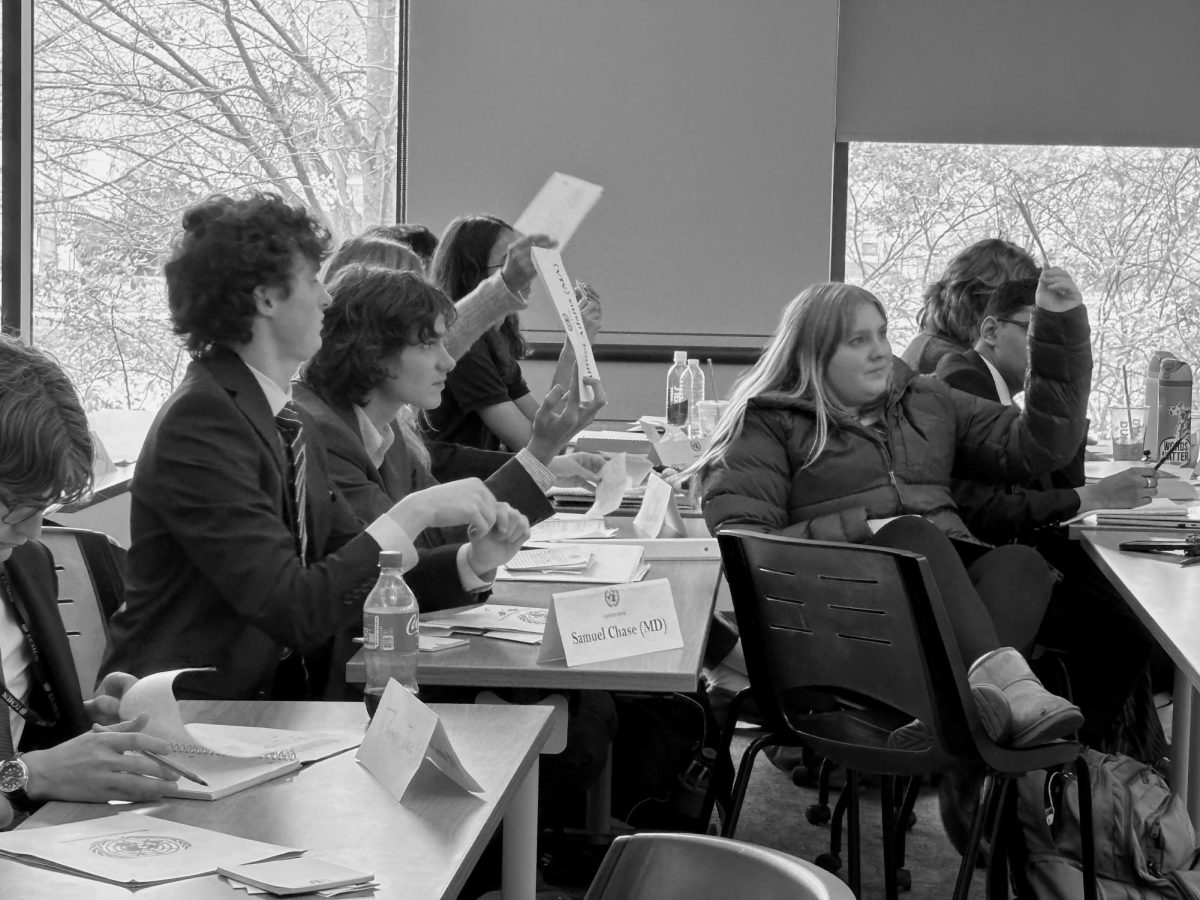
From November 7 to 9, the Haldane Model United Nations team ventured to the University of Connecticut’s Model United Nations conference. Model UN is a club where students pretend to be the United Nations and solve global issues. While attending the conference this year, Haldane students witnessed how technology has changed Model UN, for better or worse.
Once delegates boarded the bus and had dropped off their bags at the hotel, they traveled to the UConn campus. To kick things off, there was an introductory ceremony where delegates learned about the conference and the separate committees. Delegates from Haldane represented numerous countries such as Mexico, Ukraine, Tunisia, the United States, and more. For three days, Model UNers debated, furiously wrote essays, and passed resolutions to provide theoretical solutions to real-world issues such as the U.S.-China trade war. There was not much time to relax during this trip, with many delegates staying up into the early hours of the morning in order to finish position and resolution papers.
Model UN is an opportunity for young adults to experience working together in order to reach a consensus, an important quality students can bring into the workforce one day. This year, the team included more experienced students as well as younger ones. Kaitlyn Secor, a Haldane Social Studies teacher and the Model UN club advisor, commented: “I think that the trip went well because there was quite a bit of interest, and a great combination of upper and lower classmen. I feel like we are going to be able to grow the program even more. For next year, we could definitely be more well-versed in the protocol and the formalities of the conference”.
Currently, academic extracurriculars and events are faced with the challenges posed by artificial intelligence (AI). Some hosts of these events fail to outline the exact rules around AI, and in some cases fail to enforce these restrictions if in place. At the UConn Model UN Conference, the AI policy stated that AI could be used for brainstorming, but not for drafting whole sentences in any paper. Despite this, many Haldane students observed significant AI use during the conference. Haldane junior Maisie Matthews, who represented the Philippines in the Economic and Financial Affairs Council, stated: “The heads of the UConn Model UN didn’t want any of the students to get involved with AI, which is understandable.” She continued, “ Although some students used it as a search engine, which I believe is okay to a certain extent, others used it fully and still earned rewards, which I believe was completely unfair.”
In addition, according to many participants, the chairs of the committees did not reprimand delegates who used AI. This led to some confusion amidst the delegates. Sophomore Alice Stevenson, who represented Tunisia in the World Health Organization (WHO) committee, felt this confusion took away from the experience. She said, “I think that when it comes to MUN, it’s okay to use AI as a tool to guide your research. It can point you in the right direction and help you focus your research on a certain topic. That being said, I don’t believe you should use AI to generate solutions to whatever global challenge you’re trying to solve. The point of MUN is to be innovative, so you shouldn’t make AI do all the critical thinking for you.”
AI clearly has some enticing benefits, as many students turned to it for help on schoolwork and other activities, like Model UN. As our society continues to change and technology advances, it will be important for events such as UCMUN to adapt with it. Whether it be putting a complete ban on all AI use in these extracurriculars or embracing AI, it’s evident that this needs to be addressed more thoroughly. Social Studies Teacher Jeffery Sniffen, who teaches a Model UN class in Haldane’s Middle School, summed up the dilemma neatly: “In a lot of debate competitions, internet access is not allowed, so I think it’s an easy fix for Model UN conferences to not have any internet access and have everything human-generated. I get the use of AI as a thinking partner, but to ask AI to resolve an international conflict can be a scary concept. Why have diplomacy in the first place if you are going to use AI?”