



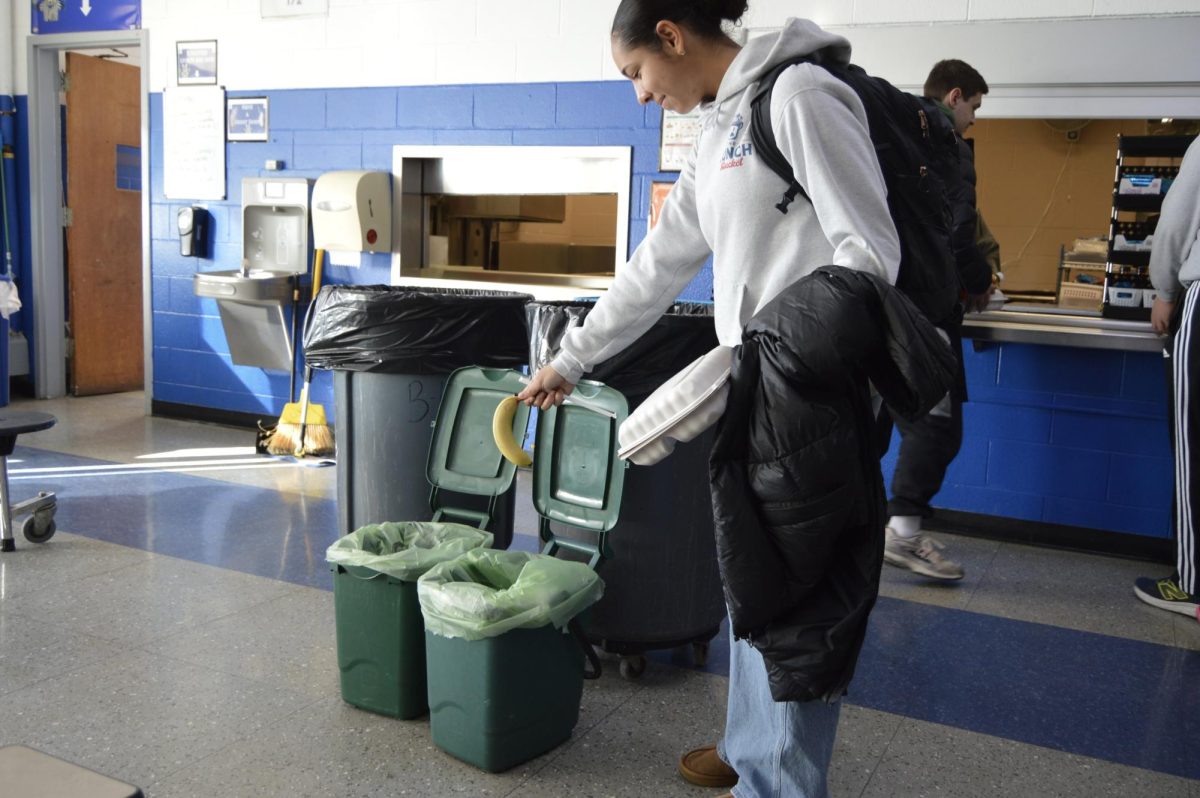
After eating lunch, many students just throw their food scraps away in the trash. But what happens after that? This was exactly the thought of freshman Allegra Clementson. Clementson, a member of the Habitat Revival Club, wanted to start an initiative for composting in our cafeteria. “Composting is taking food scraps and turning them into usable soil and fertilizer,” said senior Sofia Kelly, the president of the Habitat Revival Club. “Food scraps contribute to large amounts of carbon dioxide emissions, so it’s important we contribute to lessening those emissions.” Food scraps can add carbon dioxide to the atmosphere by wasting energy on transporting them to landfills, as well as through the release of methane, a harmful greenhouse gas, when decomposing.
This project has been in the works for years for Clementson. “I started this project all the way back in middle school,” she said. “I was reading about Philipstown Food Scraps, and I heard about them starting composting around town. I then became intrigued about sharing composting with my classmates.” According to Clementson, a small compost bin was set up in the cafeteria two years ago. However, it wasn’t used by many students. Despite this setback, Clementson continued with her initiative.
Collaborating with the Habitat Revival Club, she revisited her original idea by adding two small compost bins at the bottom of the trash cans in the cafeteria. These bins have been improved since their previous iteration. “This year, we have two smaller compost bins. As opposed to last year when we relied more on custodians, this year the bins are set up and disposed of at the end of lunch completely by students,” said Clementson. Next year she hopes to expand the compost initiative, and not just have the bins in the cafeteria, but all around school. Students appear to use the composting bins almost every day to discard the leftover carrots and other vegetables provided by the cafeteria. “I get carrots a lot, so I always put them in the compost bins when I’m done,” said freshman Allisson Estrada Ochoa.
Clementson’s plan for this project is to encourage students to discard their food scraps in a way that won’t be wasteful. Additionally, the Habitat Revival Club wants to create a project to educate their fellow students about composting. “I think it’s so important to be teaching sustainable methods in schools. It’s such an informative time in someone’s life, especially when they’re so young,” said Sofia Kelly, “if composting is normalized and people value composting, students take those values and apply them to the real world.”