


The NHS is an organization that is built on four pillars: scholarship, leadership, service, and character. This organization is not only focused on students’ grades, but also on who they are as people. The National Honor Society admits students who want to make a positive impact on their schools and communities. Membership requires students to maintain a GPA of at least 3.0 and to complete 20 hours of community service each school year.
When asked about the history of this event, High School Math Teacher and National Honor Society Co-Advisor Kristen Peparo said, “It has always been this way: the candles, the speeches, the Taconic Outdoor Education Center — except for the two years we had to hold it over Zoom because of COVID. This tradition is the same for every program across the country.” Juniors Nadine Alayon and Plum Severs commented that before going into the ceremony, they were a little worried about what they were getting themselves into, especially considering some of the more archaic traditions of the NHS. But in the end, they enjoyed the night.
Peparo presented a short speech at the beginning of the night. “[The National Honor Society was] founded in 1921 with the help of the National Association of Secondary School Principals to recognize students who had characteristics of good citizenship,” she said. Dr. Edward Rynearson founded the National Honor Society as the Principal of the Fifth Avenue High School in Pittsburgh, Pennsylvania. The creation of the NHS altered the values of American education, allowing students to become more involved in their community. In 1929, the National Junior Honor Society was established, and in 2008, the National Elementary Honor Society opened up the opportunity to all ages. The organization spread quickly, forming programs in about every state. Today, they have more than 16,000 programs across the country.
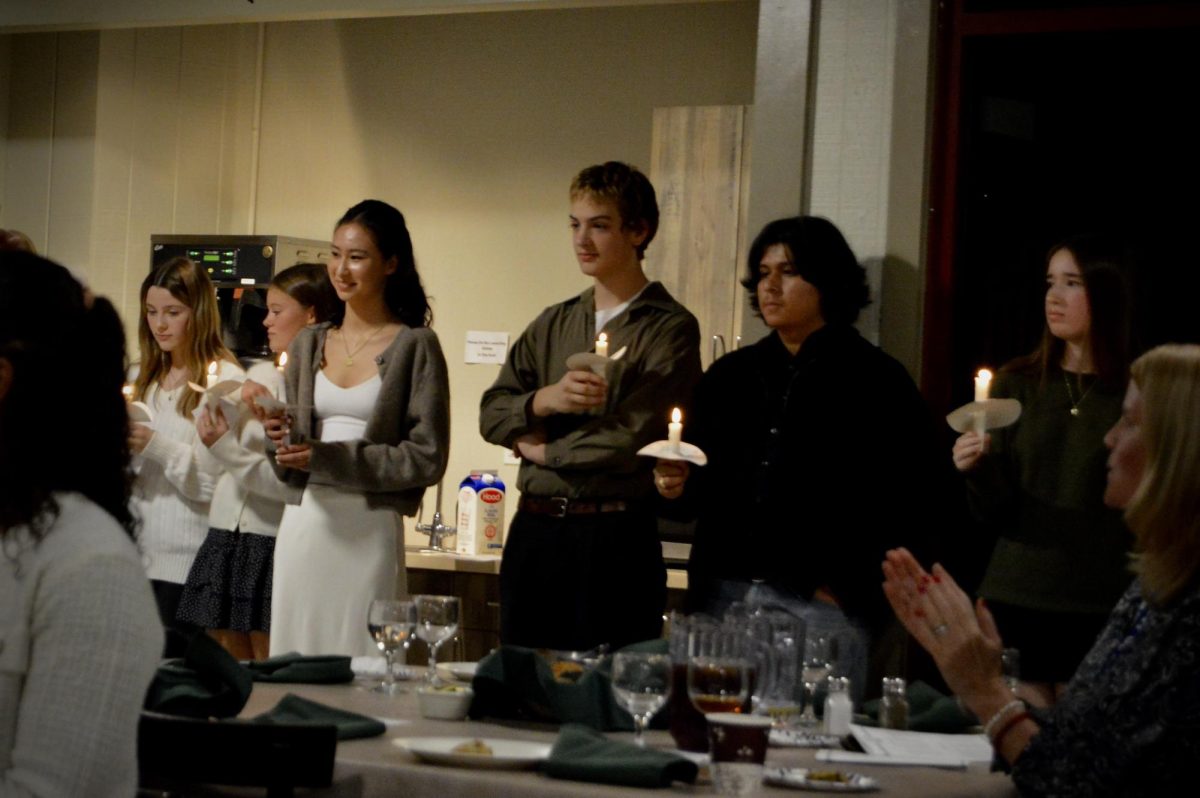
The induction ceremony began with a sit-down dinner, which included just the inductees and officers. The potatoes and salad were a favorite for many. Families joined soon after to hear students’ speeches, first from the officers and then from the inductees. Each student chose one of the four pillars and said a few words about what that pillar means to them. Junior Plum Severs noted that character seemed to be the most popular pillar among the students. She said, “It was the easiest to understand and connect with.”
The hand-held candles proved to be the most stressful part of the night; the hand protectors did not seem to work the way they were supposed to. So, along with trying not to set anyone’s hair on fire, students also had to prevent the hot wax from dripping on their hands. Junior Tess Hereford said, “The night might have been slightly stressful, but in the end, we were proud to join this society.”