


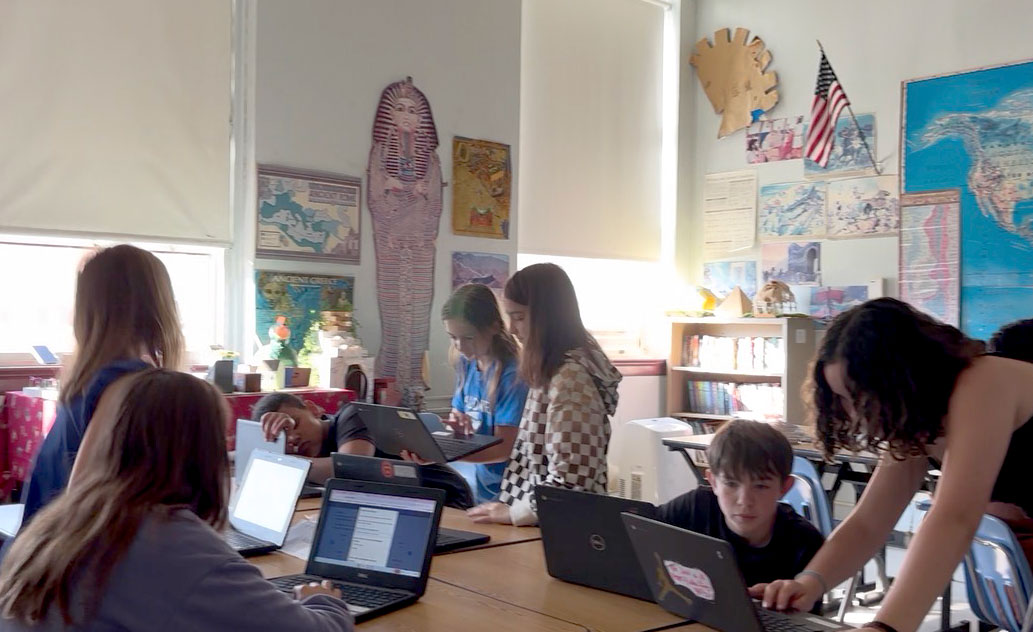
Going into sixth grade, many new Haldane middle schoolers have heard of the legendary yearlong social studies project, aptly named the Civilization Project. In this assignment, students use lessons from the ancient and medieval world to create their own civilization, and then, at the end of the year, they test it with a week-long simulation.
This project has been going on since 2010, when Jeffrey Sniffen started teaching sixth-grade social studies at Haldane. After seven years of Sniffen teaching English, the old social studies teacher, Sally LeDoyt, retired, and a spot opened up. “I was a social studies major in college,” Sniffen said, “and decided to give it a go.” He wanted the class to be student-centric. “The best way to make thousands of years of history that seems so old and irrelevant to sixth graders relevant“ was to make them do it– to make them have to create a civilization,” Sniffen said, “and then by doing that they would be a bit more connected with the material that I was presenting.”
The simulation started out as a board game, with situation cards and poker chips used for tracking population and other metrics. But ever since the COVID-19 pandemic, it has changed to a digital simulation. “When COVID kicked in, I continued with the Civilization Project, but I needed a way to play the game remotely.” Sniffen found Owen McInley, a high school senior who was interested in coding and needed an internship, to help. Sniffen said, “I reached out to him, and we remotely worked together to build what would become the Civilization Game.” And so, the Civ Project’s online makeover began.
Every year, the Civ Project has its changes, with some being drastic, and others small. Students have created a language for their civilization, while some take a different approach. “I made recipes, and I created new instruments based on all of the natural resources I had,” seventh grader Maren de Groh said, “I enjoyed the Civ Project, and I think it is a fun project.” Sniffen also changes the game each year, with the help of McInley. “This year, the map is totally infused in the game,” he explained, “So when you log in to your game board, you will have access to the map.”
Throughout the years of the Civ Project, there is one thing that doesn’t seem to change: procrastination. Eighth grader Sena Kester said, “I finished the day it was due, at like 11:30 PM. It was very stressful.” Seventh grader Gwendolyn Burgoon said, “I finished my Civ Project at about 2 a.m. the day that it was due; I do not recommend procrastination on the Civ Project.” On the other hand, some students did manage to avoid the stress by planning ahead. De Groh said, “I finished my Civ Project with four weeks left; it gave me the advantage of not losing sleep, and I was calmer.”
The Civ Project inspires creativity and teaches time management to many sixth graders, preparing them for the rigorous work to come in future years. Eighth grader Isla Hudson said, “The Civ Project taught me how to pace myself correctly so that I was paving the way for a successful academic future.”