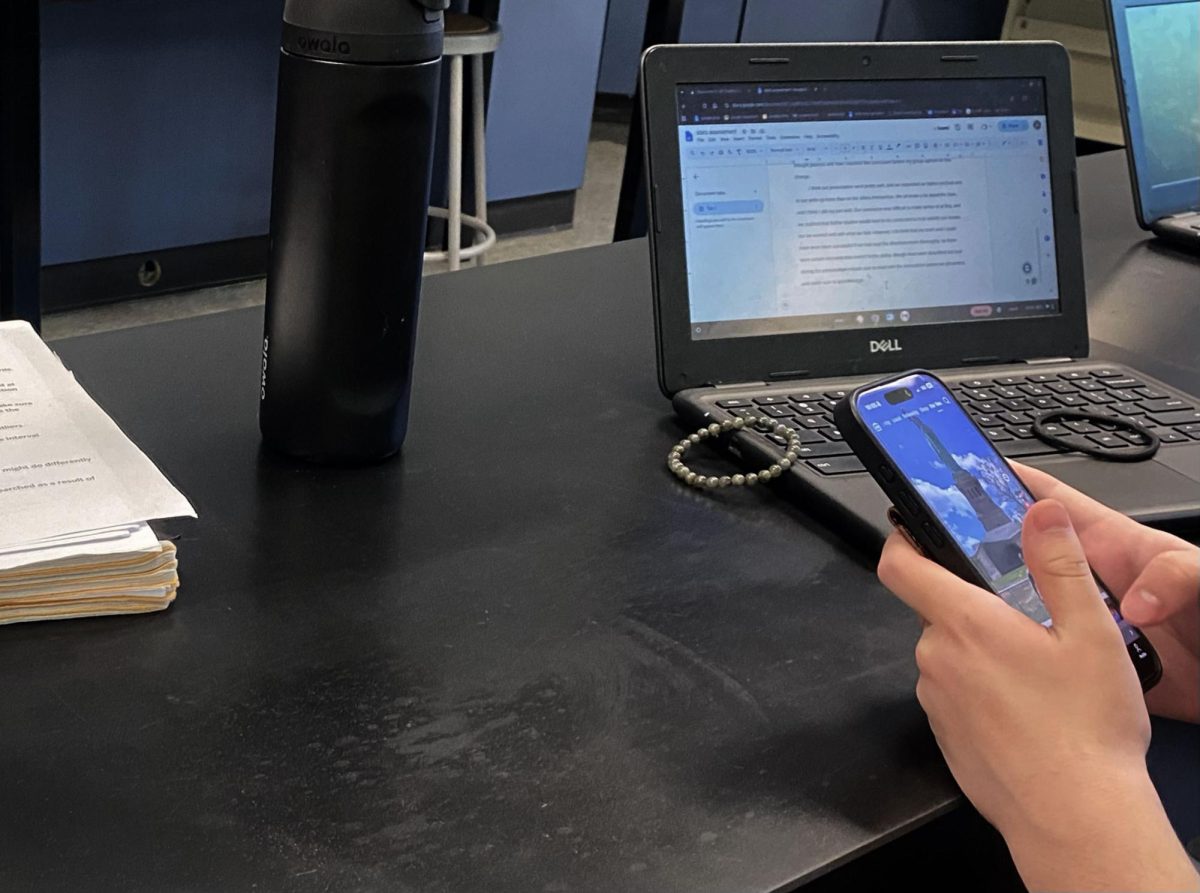





Last May, Gov. Kathy Hochul signed a bill that restricts the use of smartphones and other internet-enabled devices on school property during the school day. The law defines internet-enabled devices as “any smartphone, tablet, smartwatch, or other device capable of connecting to the internet and enabling the user to access content on the internet, including social media applications,” and the school day as “every instructional day … during all instructional time and non-instructional time, including, but not limited to homeroom periods, lunch, recess, study halls, and passing time.” With a few exceptions, these internet-enabled devices are banned statewide during the school day.
This July, in response to the law and community feedback, the Haldane Board of Education amended Policy 7316 to conform to state mandates. Previously, Haldane’s policy only restricted the use of smartphones during class periods through the use of a ‘phone pocket’ system, where students stowed their devices in a container at the beginning of the class, and retrieved them at the end of the period. Conversely, the new amendment bans all internet-enabled devices on campus from “bell to bell.” Students are now required to either have their phones in school-issued lockboxes or completely out of sight. If a teacher notices a student’s phone, they are supposed to confiscate it and send the student to the main office. This policy took effect at the beginning of the 2025-2026 school year.
Last spring, the Haldane Outlook interviewed high school English teachers Ashley Linda and Kathleen DeSocio about their opinions on the upcoming phone ban. Now that the law has been enacted, we’ve talked to them again to discuss whether their feelings have changed.
DeSocio supported restrictions on cell phones, but thought a ban coming from the state was an overreach of state authority: “I am still of the same mindset that the decision should be left to the school and the community, and it shouldn’t be a mandate from the broader government of the state because I really believe in the school’s right and its agency to determine policy for students.”
She further argued that since it is coming from the state, the phone ban is less effective: “We’re like a satellite to the state government. They have no idea what’s going on at Haldane in Cold Spring and Garrison and the communities that comprise the school district, day to day. Because they’re over there, they’re at the top, and they don’t know the differences, the nuances, and the special concerns, community to community,” said DeSocio. She cited the recent drug prevention assembly run by Haldane parent Dr. Aric Kupper as an example of the benefits of community-based initiatives.
DeSocio isn’t the only one who feels the phone ban should not have become a state law. “I think I would prefer it to just be more of a school-specific thing,” said sophomore Scout Thakur de Beer.
However, DeSocio still thinks the phone ban has had a positive impact on Haldane. When asked what changes she’s observed since the ban’s implementation, she said, “students are talking to each other more. They’re looking at each other more. They’re more engaged in what’s going on in the front of the room just because there’s no option to look down and think about their phone.”

Linda also lauds the ban’s impact on students’ social connections. She said, “the way [the ban] is creating an environment where the expectation is to not have your phone within reach is giving students the help they need to break the addiction of just constantly grabbing your phone… I also have a study hall, and I see students at lunch. And those are two of the times where I think students can be the most social. Students aren’t using their phones during those times that I see. And so I’m actually seeing students become friends and interact and have fun in study hall instead of just, like, either just doing work or playing video games.”
She also appreciates that students’ phones remain on their persons. “I like that students get to keep their phones because your phone is the property of you and your parents. I also think that some students might need the assistance of the lockbox because some students just having it in their bag isn’t enough,” she said.
While many teachers approve of the phone ban, students’ opinions are not so positive. A poll of 30 random students conducted by the Haldane Outlook found that 77% oppose the phone ban. However, 83% of students feel the phone ban doesn’t significantly impact them. Senior Seth Lunin-Pack said he opposes the phone ban “because [before the phone ban] I didn’t see a lot of people actually using their phones in classes. I figured if people weren’t interested in what they were learning, taking away one specific thing that was distracting them would make them suddenly be interested in the thing that they’re learning. But what I’ve seen is that it doesn’t really change anything; it’s like people didn’t even have their phones out in class anyway, and if anything happens, I’ve seen more people have their phones out in class now that they’re in backpacks instead of in the phone jail. But it’s just kind of a nuisance now, people will still have their phones out if they’re in the cafeteria or walking outside.”
Other students argue that the benefits of internet-enabled devices outweigh their downsides. Sophomore Kirra McCoy stated, “I don’t think that the cellphone ban has improved learning. I learn better with my phone with me because I’m able to listen to music, which helps me focus better.”
Thakur de Beer is mixed on the ban. On one hand, they said, “People talk more, which is both a good thing and a bad thing. Because, good lord, people talk a lot, and they talk to me more now, because they don’t have their distraction machines. So now, even when I have my headphones on, people will knock on my freaking head and be like, ‘Talk to me!'”
Thakur de Beer also doubts the new policy’s efficacy: “I don’t think it’s accomplished its goal of making it easier to focus and retain students’ attention and to have less phones out in classrooms, (just) because now they can legally take your phone from you if they catch you… The people still absolutely have their phones in their pockets, etc. They’re just being sneaky with it.” While the majority of students still oppose it, some look favorably upon the ban. Junior Dessa Bellamy-Tarantino, who does not bring her phone to school at all, said, “I’ve seen that students are a lot more social with each other. People are talking a lot more in the hallways. I’ve spoken to students I haven’t spoken to since 8th grade, and people seem a lot less distracted. People are more social. It feels more like a school.”
Allegra Clementson contributed reporting.