




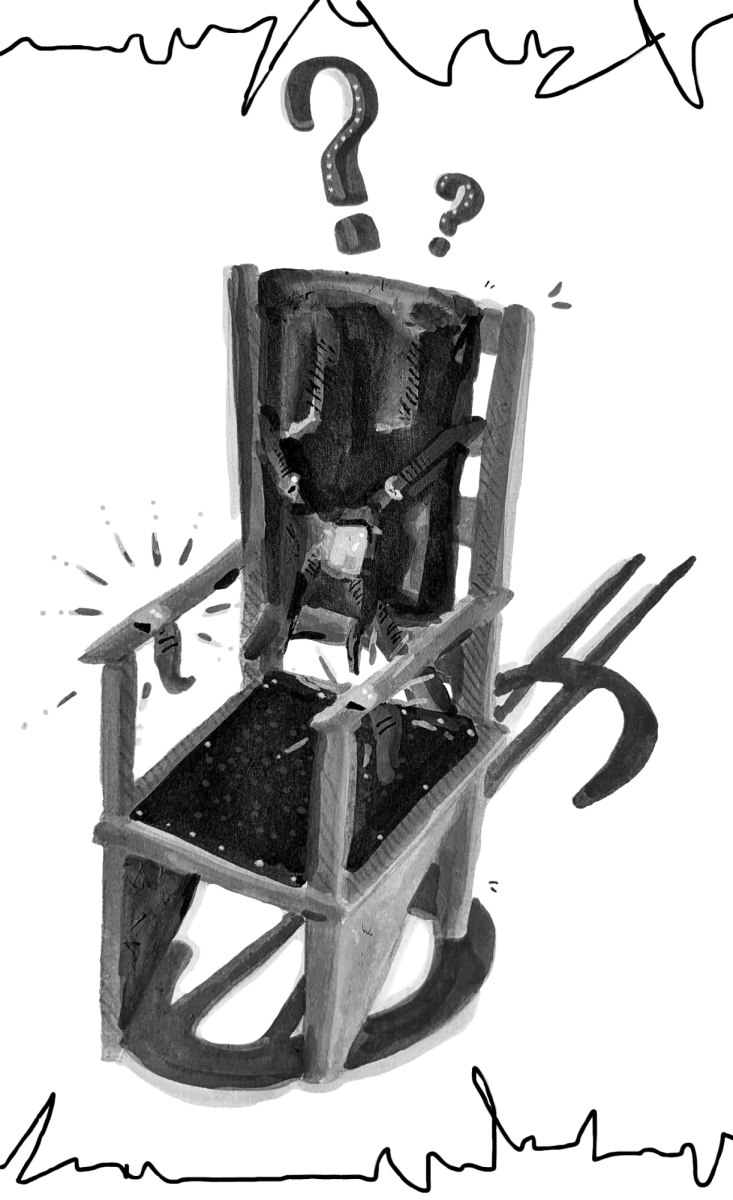
Capital punishment is one of the most fiercely contested issues in modern politics. Advocates hail it as a vanguard of public safety, while critics question whether an age that professes to be as enlightened as our own can truly justify the retention of such a practice when evidence points to it not truly being beneficial to the citizenry.
I believe that the United States should take the cue from 110 other U.N. member states and abolish capital punishment across all states for all crimes. Capital punishment is both ineffective and inhumane. It fails to prevent crime and enforce the dignity of the human individual. Furthermore, the American justice system is riddled with prejudices and systemic biases and is in no state to implement an act of such finality. It is in the best interest of humanity to abolish this fruitless relic of barbarism.
Capital punishment is both extremely expensive for the taxpayer and woefully ineffective at deterring crime. According to a study done by the Death Penalty Information Center in 2025, the death penalty costs taxpayers 2.5 to 5 times more than life imprisonment, depending on the state. A single execution can cost taxpayers millions of dollars. In Pennsylvania, for example, a 2016 study found that $272 million had been spent for each of the three executions that occurred within the state since 1978.
Perhaps such spending would be justified if the death penalty were proven to be ef fective at deterring violent crimes, but the evidence shows that this is not the case. There is no correlation between reduced crime and the use of the death penalty. States and countries that have abolished the death penalty do not see a rise in violent crime; on the contrary, murder rates are actually higher in regions that maintain the practice! This is mimicked on the global scale: A 2018 study by a human rights group in Iran examined the murder rates of 11 countries that had abolished capital punishment between 2008 and 2018, discovering that 10 out of the 11 countries included in the study experienced an overall reduction in murder rates. Expert opinion also aligns with this evidence: according to a study by sociologists from the University of Colorado, 94% of prominent criminologists agreed that there was “ little empirical evidence to support the deterrent effect of the death penalty.”
Clearly, the United States is spending ludicrous amounts of money on a punishment that has been extensively proven to be ineffective at deterring violent crimes. The energy and resources currently being funneled into the maintenance of this practice would be far better spent reducing the poverty that breeds crime in the first place by investing in employment, housing, and welfare.
In terms of ethics, the death penalty has already been denounced by numerous leading human rights organizations, including the United Nations, Amnesty International, and the Human Rights Watch, on the grounds that such a punishment is a direct affront to the right to life as outlined in the Universal Declaration of Human Rights. Human rights are not exchangeable; one does not forsake their right to life, even if they have stripped it from another. The right to life is an inherent dignity that all human beings possess. Hollow talk of revenge and retribution is futility and suffering under the guise of righteousness. To condemn a man to death is an irreversible act, and the United States has a long and tragic history of wrongful executions.
If we as a nation are determined to ensure the safety of our citizens, we have a duty to look beyond capital punishment and abolish this inhumane, expensive, and counterproductive practice. Indeed, we would be in good company. The global community has seen a trend towards abolition since the early 2000s. As of 2026, 110 out of the 193 U.N. member states have fully abolished capital punishment. Additionally, 22 nations contain laws that retain the practice, but have not executed anyone in the last ten years. Only 52 countries retain capital punishment and make frequent use of the practice.
Within the United States, things are a little more complicated as the status of the death penalty varies region by region. Florida consistently ranks as the most lethal state, with 19 executions in 2025 alone. Tied for second place are Texas, South Carolina, and Alabama with five executions respectively. On a more local level, New York ́s “Old Sparky” has not executed anyone since 1963, and in 2004, capital punishment was declared a violation of the state constitution and subsequently prohibited.
However, injustice anywhere is a threat to justice everywhere, and humanity cannot rest until every nation, state, and territory on earth bids its farewell to the government-issued knell and abolishes capital punishment for all crimes.