


When the credits of “Wuthering Heights” rolled and a group of Haldane AP Lit students left the theater, some of them were teary-eyed and others were laughing. This February, “Wuthering Heights,” directed by Emerald Fennel, was released in theaters. Between close-ups of fish jello and freaky housekeepers, this adaptation of the classic Emily Brontë novel has elicited very mixed reactions. Many criticize the film, calling it a cookie-cutter romance, but others argue that it’s exactly as dramatic as Brontë intended. Having read the book in AP Lit, we decided to judge for ourselves.
The story of “Wuthering Heights” hinges on Catherine Earnshaw’s love for both Heathcliff, an orphan raised by Catherine’s father, and Edgar Linton, her upper class neighbor. She’s more in love with Heathcliff, but decides to marry Edgar instead because Heathcliff is poor, non-white, and uneducated, and her brother Hindley despises him. When Heathcliff learns of Catherine’s choice he runs away. Years later he returns and starts frequently visiting Catherine, driving a wedge between her and Edgar.
The movie doesn’t include Hindley or the entire second half of the book, which follows Catherine’s daughter. While it makes sense to condense the complicated plot, the removal of Hindley makes Heathcliff much less interesting. In the book, Hindley torments Heathcliff because their father favors him. This contributes to Heathcliff’s underdog persona and gives him a motive for eventually buying Wuthering Heights. Without Hindley’s abuse, there isn’t much reason for Heathcliff to act as evil as he does.
Another change that erodes Heathcliff’s character is Fennel’s choice to cast Jacob Elordi, a white man, as Heathcliff. In the book, Heathcliff is described as a “dark-skinned gypsy”. His race and Hindley’s hatred for him are the main reasons why Catherine can’t marry him. But because Fennel removed Hindley and made Heathcliff white, there’s no good reason why Catherine can’t marry him, and the whole “forbidden love” dilemma kind of falls apart. Catherine choosing Edgar is the inciting incident of the story, so it’s included in the film, but it just makes no sense. For the rest of the movie, while Catherine and Heathcliff were agonizing over their separation, we were thinking, “why didn’t you guys just get married?”
The thing that makes the original story so emotionally charged is that Heathcliff and Catherine never get to be together, legally or physically. He returns just as she is dying. But half of the movie is a montage of their sneaky linkage while Catherine is married to Edgar. After the tenth time we see Catherine cheat on Edgar, it gets boring because we know from experience that he isn’t going to retaliate.
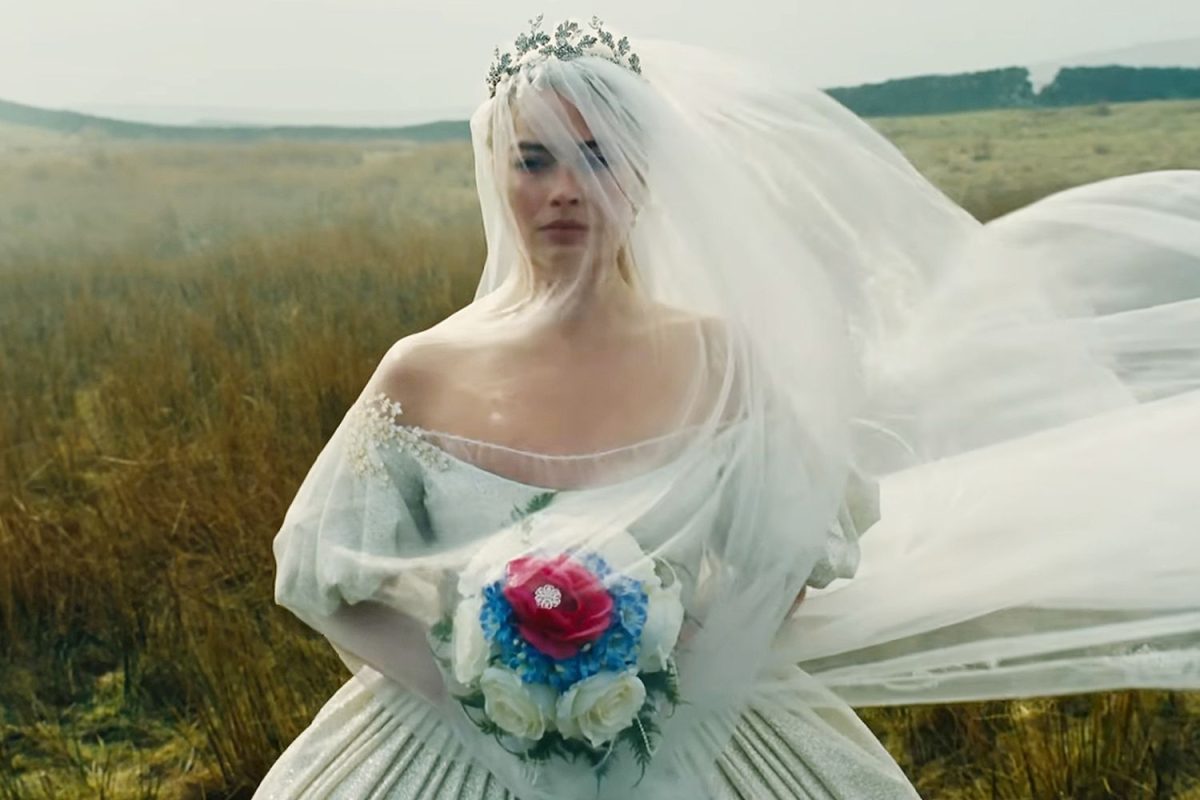
In the book, both the Earnshaws and Lintons are wealthy. In the movie, Wuthering Heights is an absolute crap shack, and Thrushcross Grange is a comically lavish YouTuber mansion. The scenes at Thrushcross Grange are fever dreams. There’s a skin room. Made of Catherine’s skin. The men wear beautiful period-accurate suits, but the women wear bubble wrap, latex, and rainbow tutus. Ball gowns are worn indoors for no apparent occasion. This makes the movie very visually interesting, but it distracts from the plot more than enhances it. Do you really want your audience wondering why Catherine’s wedding dress is made of plastic?
Although the modern set and costumes don’t quite work, the soundtrack by Charli xcx does. Her songs are used sparingly and they depict the tense, yearning mood well.
One substantial plot change that we liked was how Fennel altered Isabella. In the book, Heathcliff tricks Isabella into marrying him and then physically abuses her, and soon after she runs away. In the film, Heathcliff makes it clear that he will never love her, he’s just using her to get revenge on Catherine. Their relationship is completely transactional: Heathcliff gets revenge, Isabella gets him. This makes Isabella more interesting- while the book barely describes her relationship with Heathcliff, in the movie we see how she, as a naive girl overshadowed by Catherine, would readily allow him to manipulate her. As time passes Isabella remains happy in her toxic marriage as a rebellion against Edgar, who has kept her subdued and infantilized. This makes Heathcliff’s revenge on Catherine more effective, because his control over Isabella is more complete. Isabella is the only character who really brings out the toxicity and self-sabotage that is central to the original story, and Alison Oliver, who plays her, is the only actor truly committed to doing so.
We enjoyed watching “Wuthering Heights”. It has an interesting set, good acting and directing, and a fun soundtrack. But as for the plot, it’s much less complex in the movie. The film is more like an engaging introduction to the feelings and themes in the story than a complete narrative itself. If you want to understand why “Wuthering Heights” has been beloved for over a century, read the book.