


Let’s face it. Nobody expected “The Three Musketeers”. From the announcement to the performance, Haldane Drama’s “The Three Musketeers” repeatedly caught actors off guard.
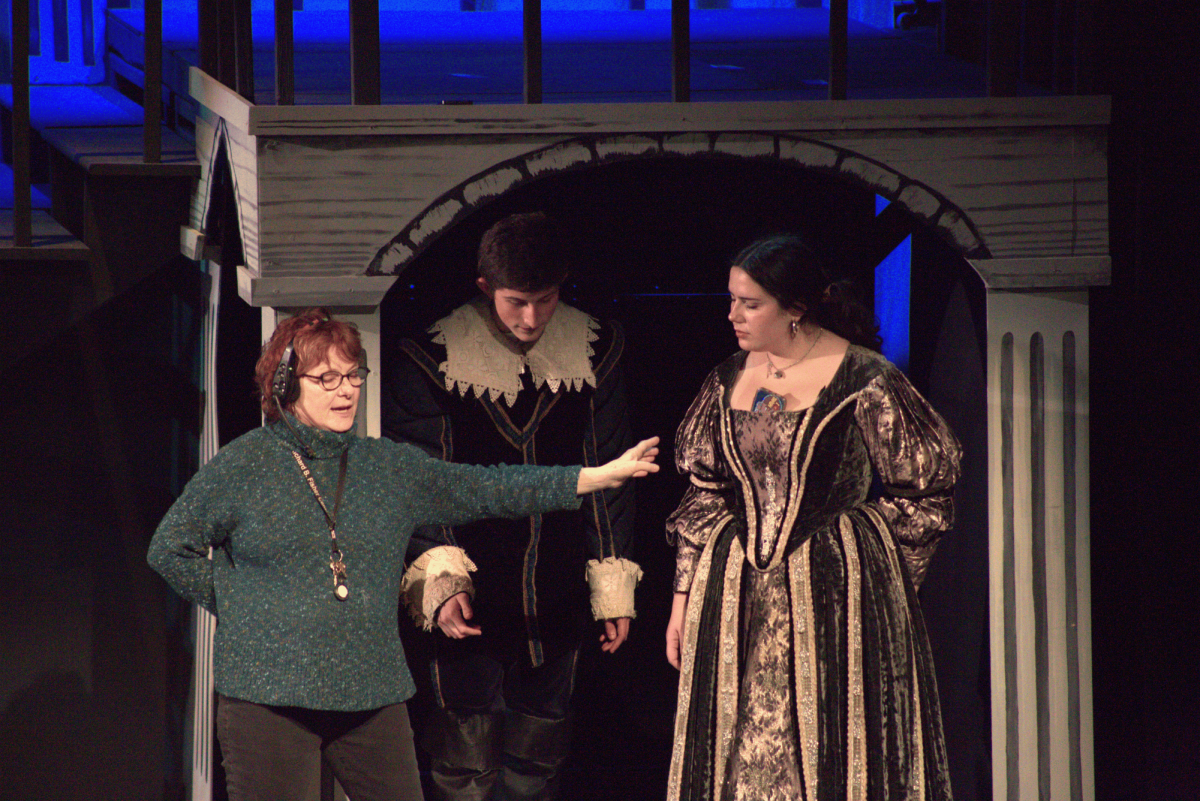
“Ken Ludwig’s ‘The Three Musketeers” was based on the novel by Alexandre Dumas. It is a historical romantic adventure. Many of the characters are based on actual people. Our heroes, Athos, Aramis, Porthos, and D’Artagnan face many moral dilemmas as they fight for justice and glory in a world of political intrigue,” stated director Martha Mechalakos. It seemed that the entire community had settled into the comfort and predictability of Haldane’s tear-jerking dramas, like “Macbeth” and “Our Town”. “The Three Musketeers” took the Haldane community on a wild, hilarious ride.
“It isn’t that it is so different,” said Mechalakos. “It requires a set of actors with specific skills. Ten or so years ago, I saw a production of this play at Hudson Valley Shakespeare. It was uproariously funny and exciting, and I picked up a copy immediately. Every year, I’d bring it out to consider producing and would put it away. But this year, it clicked.”
Some of the actors weren’t experienced with satirical shows, and every actor had a different experience practicing it this season. “I think I’m more comfortable with drama just because I’ve done more,” senior Merrick Williams said. But during rehearsals, he discovered that comedy was a relieving outlet. “It’s a lot less thinking of where the character is coming from than in drama and a lot more instinct of what makes a scene funny,” said Williams. Still, Williams favors his most dramatic scene, his confrontation with Milady (Lucia Petty), the villainess. “He can’t shake those feelings, and no matter what she does, he’s still in love with her,” said Williams. He thinks this scene will be “the hardest to pull off”, but that challenge and intensity are what make drama his go-to.
Senior Lucius Bell, who portrays D’Artagnan (the lead), believes that plays like “The Three Musketeers” require the same amount of care as a drama. According to Bell, “In comedy, you still want to embody the character, but I’m also able to use my own humor and my own ideas for what I do with the character and what happens. I’d say that in comedy there is more work on everyone’s part.”
Senior Molly Bernstein, who portrays Sabine, on the other hand, feels that satire takes more planning and precision. “Comedy is harder to land. In drama, anybody can get into the emotion and feel something realistically. With comedy, it’s often so unrealistic. You have to work with your scene partners and yourself to sort of win that timing and get a funny joke.” Senior Lucia Petty, who portrays Milady, enjoys watching dramas but prefers performing in comedies. “The thing about comedies is that there’s a balance, when dramas can easily become overly depressing.”
Mechalakos shares the opinion of many students: “Most agree that comedy is more difficult than tragedy. Although the ‘harder’ genre is one that stretches an actor’s weakest technical or emotional skill. But with comedy, as with many skills, one can improve with study and practice. Timing and pace are very important in comedy, as is reacting to real-time audience feedback. One can take a line and read it seriously. Take the same line, vary the pace of the line, add a beat or short pause for emphasis, anticipate the audience reaction, and the same line becomes funny. Comedians often also work on improvisation. It helps one to think quickly and be spontaneous to adapt to the audience or situation.”
Before the play’s announcement, many of the actors weren’t aware that “The Three Musketeers” was a play, though they had seen the movies or read the book. “Surprised” and “shocked” were the feelings of Petty and Bernstein. “I kind of just immediately thought of Mickey Mouse,” said Williams, referencing the Disney movie, “Mickey Donald Goofy: The Three Musketeers”. But upon looking into the show, the excitement immediately set in. “I made the assumption that this was the kind of show that would take some external help with all this sort of fighting and dancing and that it would be a new kind of show for me,” said Bell.
All of the students had to do their research. While looking into the show, Williams noticed that all characters were instrumental to the plot. “I mean, even in the audition, I didn’t really know who I wanted. There were three musketeers. None of them is technically the leader. Each one had its own characteristics.” The choices of playwright Ken Ludwig piqued Petty’s interest during her pre-audition investigation. Ludwig added the character of Sabine, a character that Alexandre Dumas’s original novel lacked. Sabine is D’Artagnan’s little sister who dresses as a boy and joins the Musketeers, serving the ultimate revenge and saving the day. “Sabine’s character really proves that women can fight as equally as men. Same thing with Milady. They’re both very powerful, very outspoken, opinionated characters, which I feel like you don’t get to see a lot of in theater,” said Petty. There are no helpless female characters in Ken Ludwig’s “The Three Musketeers”. “It was great to see someone actually like myself,” said Bernstein.
What really makes this show is the incorporation of movement. Mechalakos commissioned Gabriel Rosario, a graduate of the American Musical and Dramatic Academy, to choreograph all combat scenes. The action doesn’t just include swordfighting; there is hand-to-hand combat, stabbings, shootings, poisonings, and stranglings throughout the story. In Williams’ opinion, the amount of conflict in “The Three Musketeers” exceeded that of “Macbeth”. Both Petty and Bernstein consider their final swordfight their favorite scene, and Bell believes that his opening battle with senior Owen Powers, who plays D’Artagnan’s father, sets the mood for the rest of the show.
Bell noticed the lack of swordfighting in particular scenes, and how it created a nice balance: “There’s a lot of sword fighting in the first act, and then less so in the second act because it’s more about protecting the queen. It highlights the other duties that a musketeer has to accomplish.” Aine Duggan’s (Queen Anne) favorite scene is one of these non-combat action moments, where the Musketeers and Co. perform an elaborate handing-off of gems to Queen Anne.
“What I’m really surprised about is that we had a choreographer and we’re dancing. Oh, yes. That threw me off. I had no idea that was happening,” said Williams. Mechalakos recruited Cedric James, a contemporary hip-hop/musical theater choreographer, to organize the ballroom scene and several musical montages. He has worked on shows at The Center for Performing Arts at Rhinebeck, Arlington High School, Dutchess Community College, and Rhinebeck High School. Haldane’s “The Three Musketeers” featured classical ballroom dance as well as funky hip-hop breaks. Throughout the show, audience members may feel inclined to dance along to “Sledgehammer” by Peter Gabriel and songs by Pink Floyd. Duggan, who prefers musicals to plays, was pleasantly surprised by these choices: “I was like, ‘wow, this is really making me feel like it’s the musical without the singing!’”
The story itself resonated with Mechalakos. “Through [the leading characters] we see the power of friendship, loyalty, courage, and honor, and how difficult it can be to stay true to oneself and beliefs,” explains Mech. However, the story means something completely different to the actors and actresses who spent long nights in the quiet school.
For Duggan, this is her very first fall play, and “first time with a big speaking role.” To Duggan, “The Three Musketeers” has been “branching off, making new friends, and also making the transition from my volleyball life to the world of drama.” At first, she felt tentative about being the only one in her friend group to express interest in theater. “I remember sophomore year, I was very nervous to do it. I really am happy that I went off and did it by myself. It even strengthened some past relationships that I had. Now I have even more friends and even more support in my life.” To Petty, “The Three Musketeers” has been a group effort. “I feel like, compared to “Into the Woods” especially, this show has such a unique community feeling because of its short length. We’re all working together, and there’s a lot more group scenes, and it feels very collaborative.”
In fact, there are no long scenes or monologues. Rather, “The Three Musketeers” is a fast-paced collage with quick transitions, making it feel shorter than it really is, especially in comparison to last year’s Macbeth. Blink, and you’ll miss it.
The students have been exploring and personalizing their characters for months. A few cast members shared three-word interpretations of their characters:
Lucius Bell (D’Artagnan): “Curious, excited, and forthright.”
Merrick Williams (Athos): “Driven, conflicted, and jaded.”
Molly Bernstein (Sabine): “Energetic, optimistic, and determined.”
Lucia Petty (Milady): “Strong, scarred, and seductive.”
Aine Duggan (Queen Anne): “Headstrong, sneaky, and unfulfilled.”